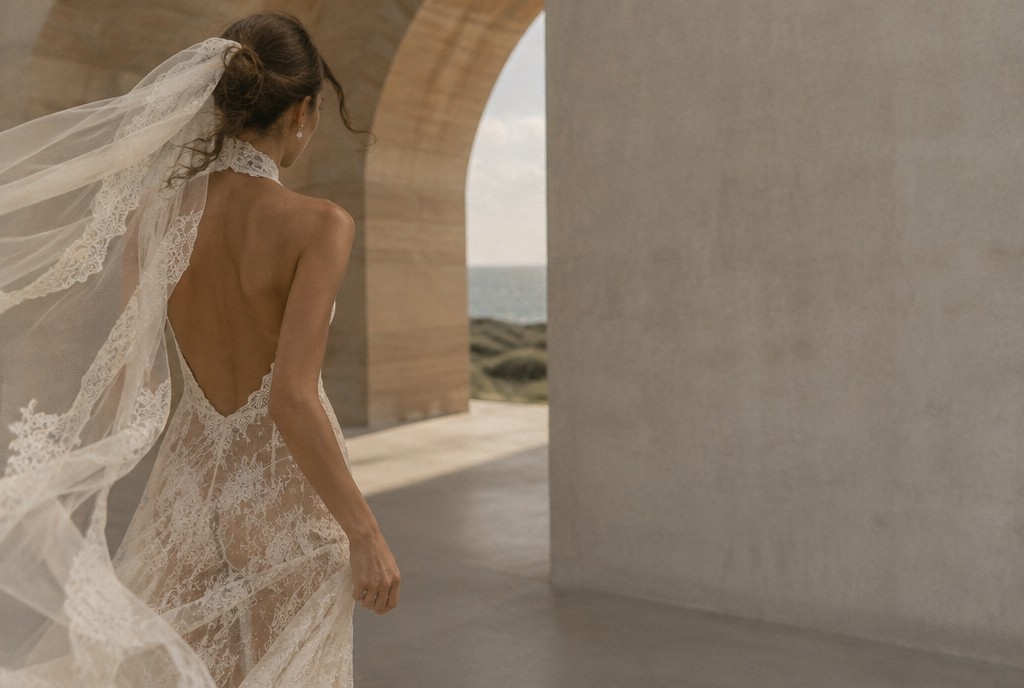
Lace has been a bridal staple for generations, which makes it hard to say anything new about it. Yet the spring 2027 bridal collections suggest designers are finding plenty. The lace appearing now is lighter, more sheer and more sculptural than the heavy, all-over versions many people remember.
Coverage of New York Bridal Fashion Week describes Chantilly lace layered and floating over sheer fabric, lace running through veils and trains, and two-tone looks that pair lace with black suiting. FashionUnited, reporting on the autumn and winter 2027 bridal shows, writes of lace turning three-dimensional, with architectural volumes and dramatic sleeves. It is a more confident, slightly more modern way to wear a very old fabric.
The halter and the open back
Two shapes appear again and again. The halter neckline offers coverage at the front and an open back, which suits anyone who wants a dress that feels secure and still has a little drama when you turn around. In lace, it has a gentle, vintage feel without looking like a costume.
The open back also does something practical for an Australian wedding. It lets air in. If your ceremony is outdoors in the warmer months, a fine lace over a light lining with a bare back is far more comfortable than a heavy, fully covered bodice.
Sheer, layered and a little undone
The newer lace dresses lean on transparency. Sheer overlays, soft tulle and fine Chantilly sit over simple slips so that the skin and the shape of the body read through the pattern. Asymmetry shows up as well, in a sash falling from one shoulder or a draped section that reveals a flash of sheer fabric.
If you are drawn to this look, spend time on the lining and the foundation. A beautiful sheer dress depends on what lies beneath it. Ask your designer or fitter how the underlayer will move, whether it matches your skin tone or your preferred shade of cream, and how it will behave if you sit, dance or climb stairs.
Colour that softens
The shade of the lace matters as much as its pattern. Reports from the spring 2027 shows describe a move away from stark white towards deep creams, soft greys and pastel tones. A cream or warm bone lace tends to flatter most skin tones and reads beautifully in natural light, especially in outdoor settings with sandstone or timber.
If you are unsure, take swatches outside. Salon lighting can be unforgiving or flattering in ways that outdoor light is not. Look at the fabric in the shade, in open sun and, if you can, in the kind of light you expect at the time of day your ceremony will be held.
Styling the details
Lace already has plenty to say, so the rest of the look can be quiet. A smooth low bun or loose, slightly undone hair lets the neckline and back do the work. Simple earrings are usually enough. A veil edged in matching lace creates continuity, while a plain tulle veil can sit beside a busier dress without competing.
Think about how you will be seen from behind. With open backs and trains, your guests will spend a good part of the ceremony looking at the back of your dress, so it is worth asking to see it from that angle in a mirror and in photographs during your fittings.
Care and wear
Lace is delicate, and a day of hugging, dancing and walking across grass can be hard on it. Ask your designer about the weight of the fabric, how it will cope with the weather and what you can do in advance, such as having a bustle fitted so the train does not drag. Keep a small repair kit with your bridesmaids or planner, with matching thread, a needle and a few safety pins.
If you plan to change for the reception, a lace gown can become the ceremony look and something lighter can take over for the party. That is one way to enjoy the romance of lace without asking it to carry twelve hours.
Making it yours
The best lace dresses do not look like a trend. They look as though they were made for the person wearing them. Try on a few shapes, including one you did not expect to like, and notice how each makes you stand and move. The right one will feel easy before it feels beautiful.