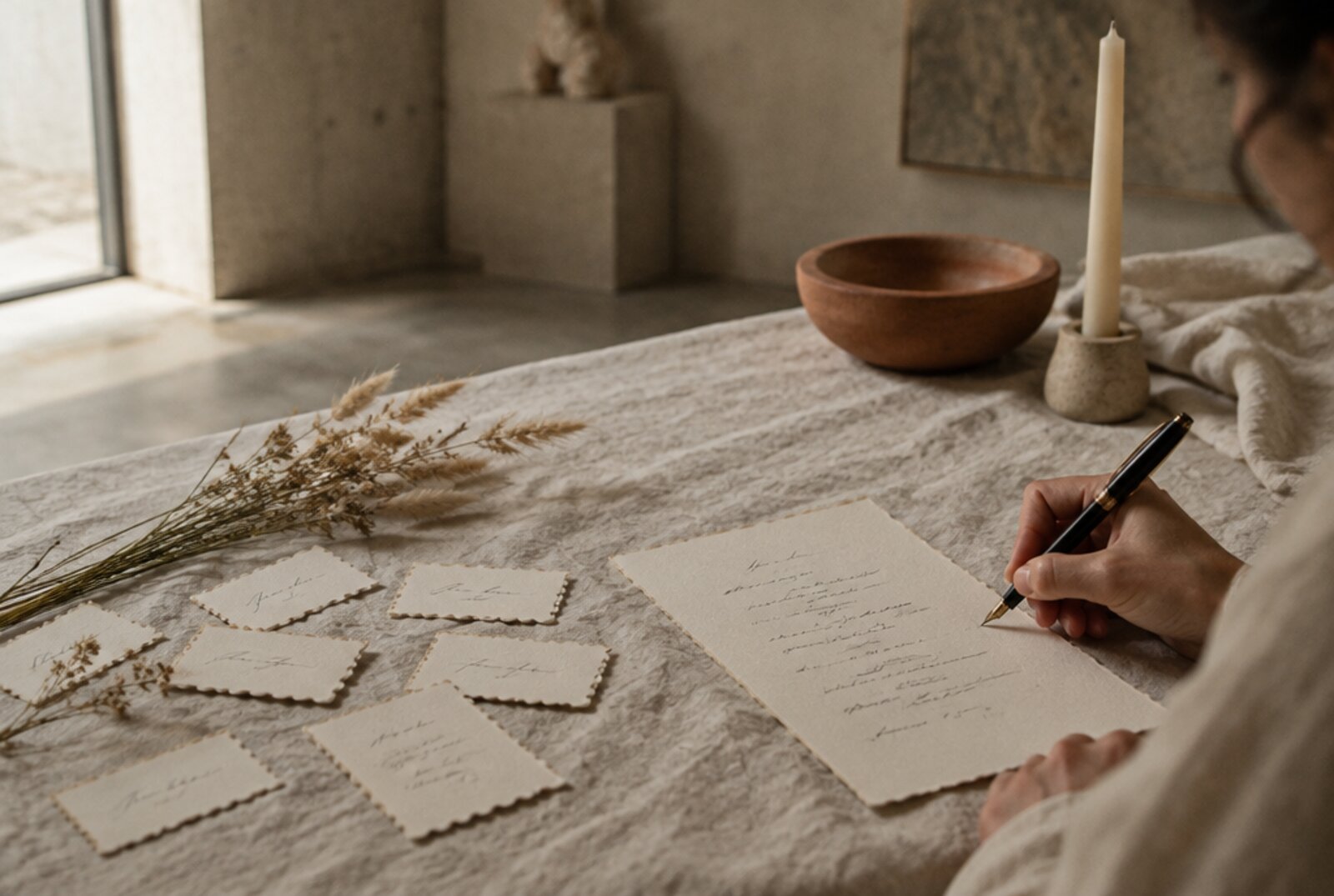
Wedding stationery has spent years in a polished lane. Clean serif type, generous white space, a small monogram. It is beautiful and it still looks good. But a quieter shift is under way, and it begins with something very old. A pen, held by a person.
Bridebook’s 2027 forecast describes editorial stationery paired with handwritten touches, with doodles, chalk signage and playful shapes such as scalloped edges. The Bridal Journey’s recent trend roundup makes a similar point, noting handwritten menus as one way couples are putting personality ahead of perfection. The idea is simple. Keep the design restrained, then add something that could only have come from you.
Where a handwritten element works best
Not every piece of paper needs to be written by hand. The most effective approach is to choose one or two places where it will be noticed.
Place cards are the obvious start. Guests find their own name written in ink and feel welcomed before the first course arrives. A handwritten menu card, one per table or one per setting, makes a dinner feel like a dinner party at home. A short note tucked into each welcome bag costs very little and is often kept.
Signage is another strong option. A chalk or paint-pen welcome sign, a bar list, or a sign pointing to the late-night food can sit beside a printed order of service without clashing. The contrast between the two is exactly what makes the room feel considered.
Getting the look right
Choose paper with some tooth. A heavy cotton stock, a deckled edge or a gentle scalloped cut gives ink something to sit on and makes even simple writing feel special. Pair it with a restrained colour palette. Black or deep brown ink on cream or bone paper is timeless, and a soft terracotta or sage works if you want a hint of colour.
Keep typography minimal on the printed pieces, then let the handwriting carry the personality. If your invitation suite is crisp and modern, a single line in your own hand on the envelope or the reply card can be enough.
Think about legibility. A beautiful script that guests cannot read is a missed opportunity. Test a few names and dishes on a sample card, and ask someone at arm’s length to read it.
Who does the writing
You have three realistic options, and each has its place. You can write it yourselves, which suits a small guest list and a few quiet evenings. You can ask a calligrapher or a hand-lettering artist, who will bring consistent style and speed. Or you can mix the two, with a professional for the invitations and your own hand on a handful of personal notes.
If you are writing yourselves, practise first. Buy extra stock for mistakes, use a pen that does not smudge, and write in batches rather than one marathon session so your hand stays steady. Lay the cards flat to dry before stacking them.
If you are hiring someone, ask to see a full alphabet sample and a recent suite of work. Confirm turnaround times, whether they can work from a guest list spreadsheet, and how they handle corrections. Do this early, because skilled stationery makers often book out many months ahead.
Practical details that save time
Finalise your guest list before anything is written. Names with unusual spellings are worth checking with the guest directly. Order more cards than you need.
Decide how the writing will be displayed on the day. Place cards need a sturdy base or a small holder. Menus read well when propped against a glass or laid across a napkin. Candlelight is lovely, but make sure there is enough light to read by.
Consider how you will keep the pieces afterwards. Many couples collect a menu and a place card each, and a handwritten keepsake sits well in a frame.
A small gesture that lasts
Technology has made the wedding invitation faster than ever. A line written by hand does the opposite. It slows the moment down and tells your guest that someone took the time.
You do not need a calligraphy course or a large budget. A steady pen, a good piece of paper and a few honest words will do.